What this guide proves
The six-axis arm can be read, homed and moved through small, supervised bench motions with unique servo IDs, correct joint directions, conservative limits and a known stop method. Planning comes after this hardware acceptance.
Hardware and scope boundary
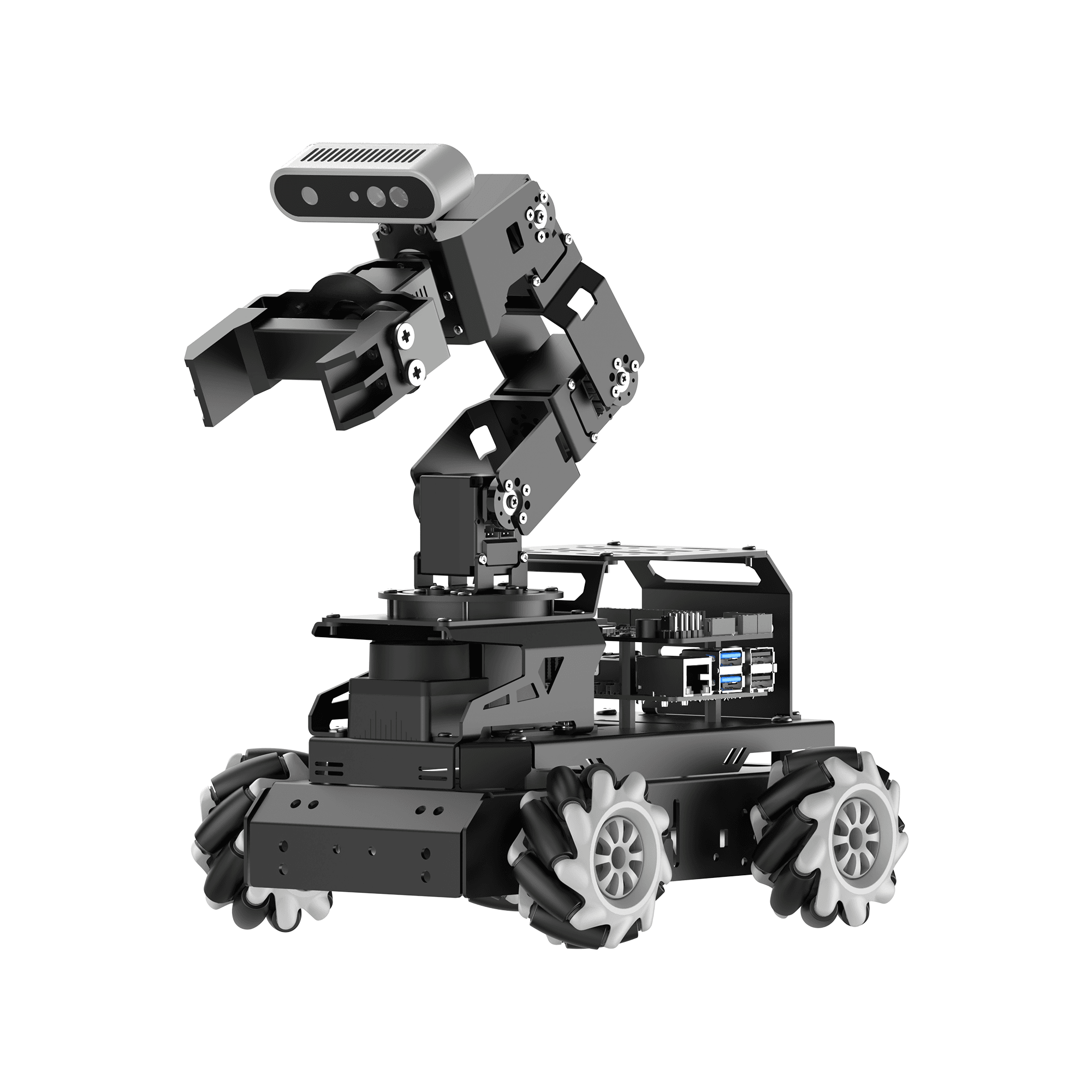
COG-L1-6DOF-ARM includes the arm, gripper and six HX-06L intelligent bus servos. It requires a protected 6–8.4 V servo rail and a 115200-baud half-duplex UART controller. The 410 mm reach and 100 g payload are planning references; mobile-base load, pose and speed must be validated separately.
Prepare before applying power
Use a rigid bench or stable base, clear the full workspace, remove fragile payloads and confirm cable strain relief. Do not power the servos from Raspberry Pi GPIO or its 5 V rail. Record all existing servo IDs and preserve a known-good controller firmware before changing settings.
Procedure
- Verify a unique ID for each bus servo and read back angle, voltage and temperature if the delivered controller/firmware supports it. Never broadcast a configuration write when IDs are unknown.
- Define mechanical zero and joint direction with the arm supported. Check gripper as a separate axis and keep its reference payload below the validated condition.
- Create or validate the URDF joint order, limits, collision geometry and arm-to-base transform from measurements rather than promotional drawings.
- Run small position moves in an empty workspace. Observe current/temperature behavior, mechanical interference and whether a stop command is available at the controller layer.
- Only after direct joint tests pass, configure MoveIt 2 with conservative velocity, acceleration and workspace limits. Review every planned path visually before executing it on hardware.
Pass criteria and record
The record includes servo IDs, rail voltage, controller firmware, mechanical-zero notes, URDF/limit source, joint test result and the explicit emergency stop or power-removal procedure.
Do not proceed when
Stop for duplicate or unknown servo IDs, a supply that cannot support the simultaneous load case, unexpected motion, high temperature, joint collision, cable pull or an unverified arm-to-base transform.
Continue from here
For mobile manipulation, validate base stability and a separate camera/hand-eye workflow before combining base motion with arm motion.