Selection & Case Study
Selection case: define interfaces before choosing a controller
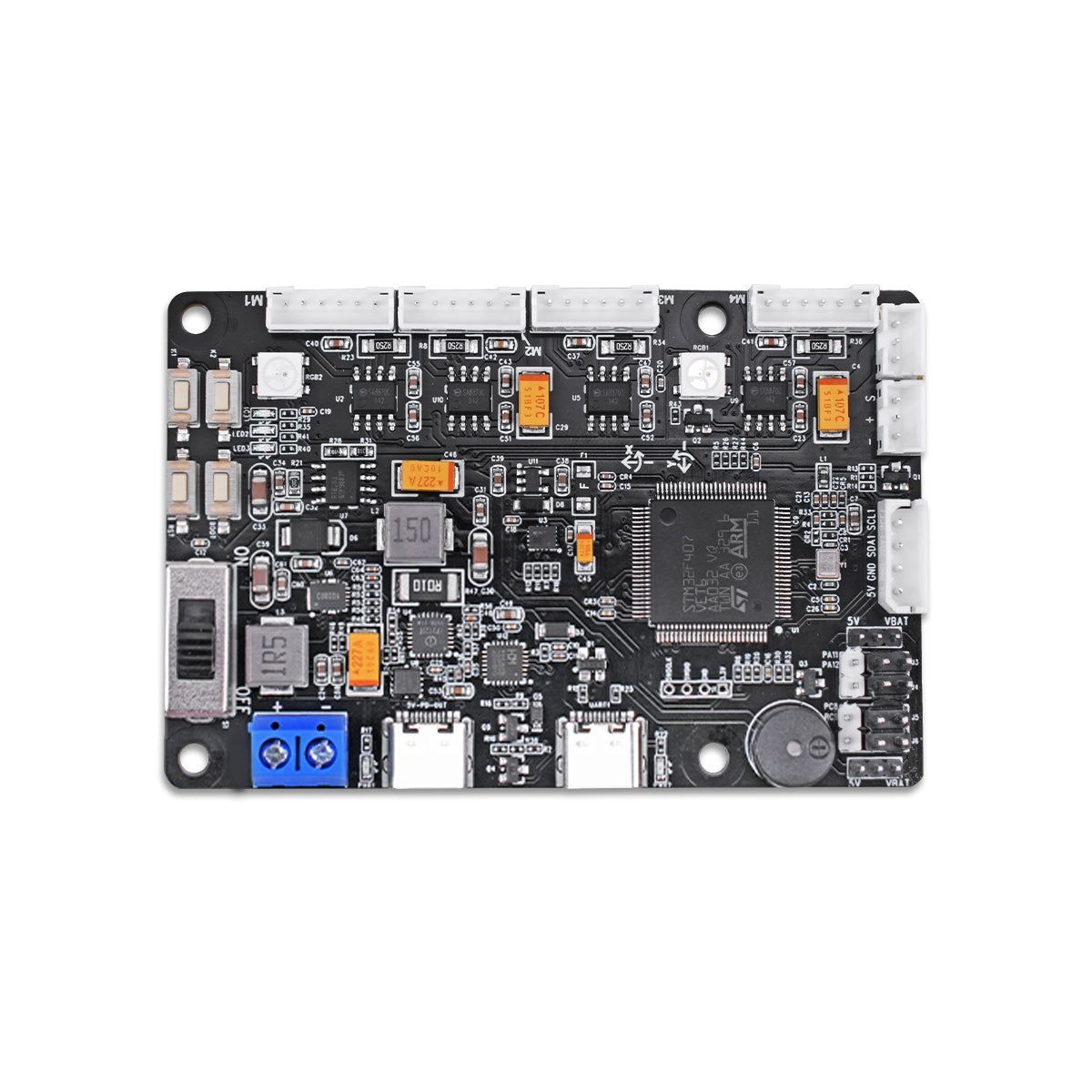
Use a concrete interface matrix to select host compute, real-time control, sensors and actuators before committing to a board.
The case: a controller is chosen before the robot is described
A board comparison can feel decisive but it often happens too early. The right controller follows from the robot’s required signals, time behavior, power rails, safety stop and physical layout—not from its processor headline.
The first document should therefore be an interface matrix. Each row represents a capability the complete robot needs to demonstrate, and each column makes a technical condition visible.
Write functions as measurable flows
A Mecanum robot needs four motor commands, four encoder feedback paths, a coordinate convention and a safe command timeout. A tracked navigation robot needs left/right drive and feedback, a continuous scan, transforms and a host path. A 6-DOF arm needs a protected servo rail, half-duplex bus, unique IDs and joint limits.
These flows identify the actual selection questions: channel count, signal levels, update rate, bus type, voltage/current, connector, software ownership and failure state.
Example: split host compute from real-time I/O
COG-RPI5-8GB is a capable Linux, ROS 2 and perception host with a recommended 5 V / 5 A path. It should not be asked to provide deterministic encoder-motor timing or drive a high-current actuator rail directly.
COG-RRC-LITE provides an STM32 real-time MCU, four encoder-motor channels, IMU, PWM and serial-bus-servo ports, with a Pi 5-compatible host-power path. Its actual firmware, harness and chassis mapping must still be confirmed for the chosen robot.
Example: do not label all sensors as interchangeable
COG-MS200-LIDAR supplies compact UART-based 2D ranging for a single horizontal plane. SENSOR-001 offers a different 2D LiDAR package with different stated optical, power and data conditions. COG-AURORA930-PRO adds RGB-D data through a USB path and requires its own lighting, mounting and camera-frame validation.
The interface matrix should state what each sensor measures, where it is mounted, what it cannot see, its power rail, data connection, frame name and what application consumes it.
Convert the matrix into an acceptance plan
Every row needs an observable test. Confirm a power rail without motion, a controller link with read-only data, one actuator channel under protection, raw sensor data, transforms, then application behavior. This makes component selection testable rather than promotional.
Keep a versioned record of firmware, OS, driver, connector pinout, transform values and command limits. A board that cannot be integrated reproducibly is not the right solution, regardless of its features.
Decision rule
Choose the smallest combination of products that satisfies every documented interface and leaves maintenance access. Add optional capability only when it serves a named task—RGB-D for 3D geometry, a voice box for human interaction, a 6-DOF arm for manipulation—not because it makes a photograph look more complete.
This process produces a build that can be priced, assembled and supported honestly, with no hidden dependency left to be discovered after purchase.
Ready to turn the method into specific parts?
Browse the parts catalogue