A practical method for turning a catalogue selection into a build a second engineer can assemble, test, diagnose and extend.
The case: a team needs more than a shopping list
A single component can be technically correct and still fail to create a usable robot. The failure often appears at an unstated boundary: the controller does not match the motor encoder, the camera has no stable power path, the LiDAR has no clear scan plane, or nobody records the frame convention.
A repeatable build treats each selected SKU as a system role with a verified input, output, mounting condition and acceptance result. The first deliverable is therefore a build record, not just an order confirmation.
Start with a capability chain
Write the result the robot must demonstrate in one observable sentence. For example: a supervised tracked robot can publish a continuous 2D scan, build a small indoor map and repeat one short route. This immediately reveals the minimum layers: mobility, real-time control, host compute, perception, power and geometry.
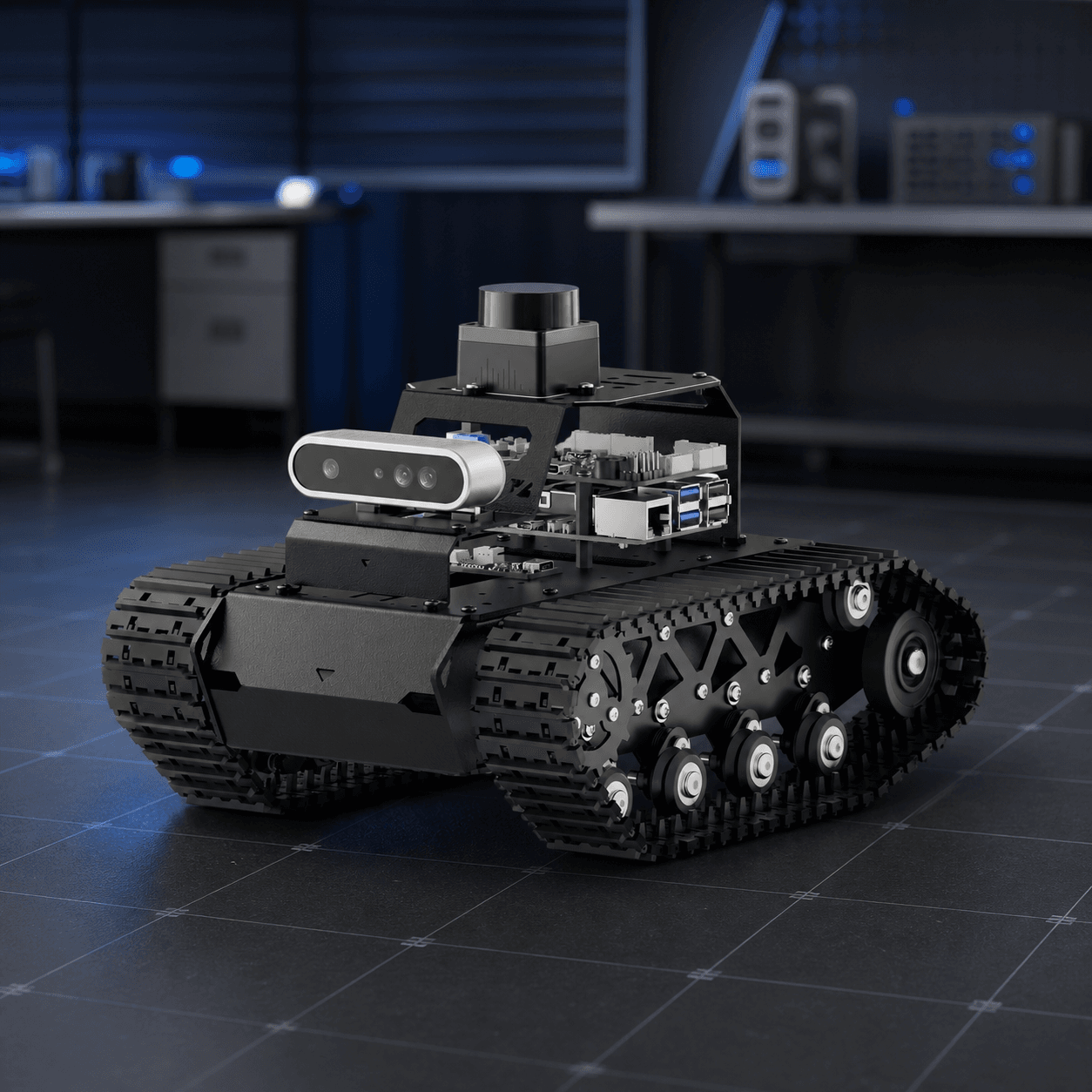
For a current navigation reference, COG-T1-TRACK-BASE provides the tracked structure, COG-RRC-LITE can be the low-level integration layer, COG-RPI5-8GB hosts Linux and ROS 2, and COG-MS200-LIDAR supplies planar scan data. The system still needs confirmed wiring, firmware and mounting.
Make every interface visible before purchase
For each connection, record voltage range, peak-current expectation, connector, polarity, logical interface, baud rate or bus protocol, mechanical clearance and service access. A short interface table is more useful than a long compatibility claim.
The same check separates products that look similar. COG-MS200-LIDAR is compact and UART-based; SENSOR-001 uses a different mechanical package and published UART/power details. COG-AURORA930-PRO is an RGB-D USB module. They should be selected for the required measurement task, not merely because they all appear under sensing.
Create a staged acceptance plan
Accept the build in layers: mechanical condition and power without motion; controller link and feedback; one-channel motion; raw sensor data; coordinate frames; then map, planning or application behavior. A layer must be repeatable before the next layer is allowed to obscure it.
The record should include firmware and software versions, photos of wiring and sensor mounting, command limits, a saved raw log and the exact observed pass/fail result. This converts future maintenance from memory into evidence.
Treat product boundaries as design inputs
A Raspberry Pi 5 bare board does not include its cooling, storage or power supply. A Cogalloy L1 Mecanum base is not a complete robot. A 6-DOF arm needs its own protected servo rail and controller. A voice box is not an emergency stop or a motor controller.
Stating these boundaries early avoids the most expensive integration mistake: discovering a missing or incompatible subsystem only after a mechanically complete assembly exists.
The output is a reusable baseline
A successful first build is not defined by the largest feature list. It is a configuration that another person can power up, identify, test and restore after an update. Its purchase list, interface table, coordinate frames, software versions and acceptance data travel together.
That baseline can then grow into Mecanum motion, RGB-D perception, arm planning or voice interaction without losing the ability to diagnose what changed.
Ready to turn the method into specific parts?
Browse the parts catalogue